Macedo, M., Oyarzún, M., Candia, C., & Hidalgo, C. A. (forthcoming). Cultural Proximity Reveals a Local Premium in Collective Memory. PNAS Nexus.
Abstract
Collective memory - shared information about the past that shapes a group’s identity - is often examined through constructs such as familiarity or salience, conflating its local and global components. Here, we untangle these components using multilingual online attention traces for over 50,000 Wikipedia biographies spanning 137 billion pageviews and validate the resulting measures with a large-scale behavioral experiment in which more than 41,000 participants answered randomized questions about them.
Locality reflects attention concentrated within a single language, and globality reflects its distribution across multiple languages. Both dimensions significantly explain recognition, revealing a robust local memory premium: people are around 10 percentage points more likely to recall someone from their country and 5 points more likely when they share a language.
Major life events such as Nobel Prizes, Oscars, and deaths produce brief local surges but slower, sustained global increases. Thus, collective memory is not a uniform accumulation of fame but a structured field of cultural proximity, offering a spatially nuanced view in which local and global audiences exert measurable influences on historical visibility in the digital age.
How the study works
Step 1 - Split collective memory into local and global attention
The paper starts from a simple observation: two people can be similarly notable, but remembered in very different geographies. Johnny Unitas and Elinor Ostrom were both born in the United States in 1933. Yet Unitas receives most of his Wikipedia attention in English, while Ostrom’s attention is more distributed across languages.
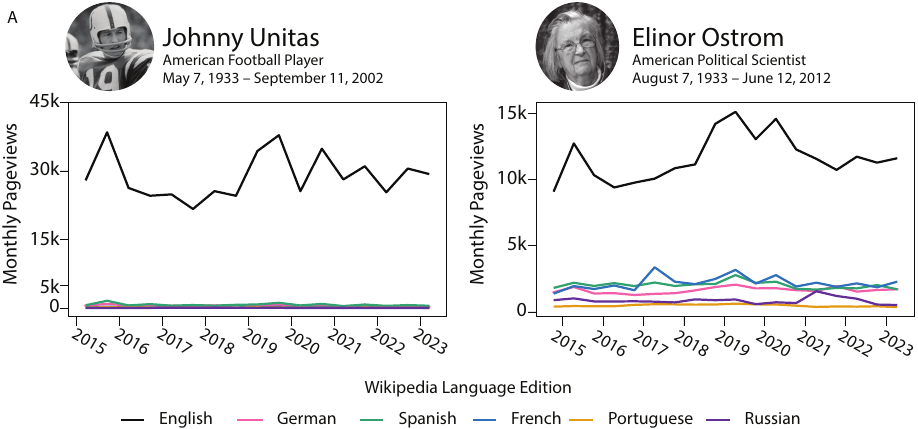
The paper uses contrasting biographies to motivate the difference between local and global collective memory. Johnny Unitas receives highly concentrated attention in English; Elinor Ostrom receives a smaller but more internationally distributed audience.
That difference motivates two measures:
- Locality - how concentrated a biography’s attention is in the language where it is most visible.
- Globality - how broadly a biography receives above-expected attention across languages.
Together, these measures let us move beyond a single scale of “fame” and ask whether a figure is locally dominant, globally distributed, both, or neither.
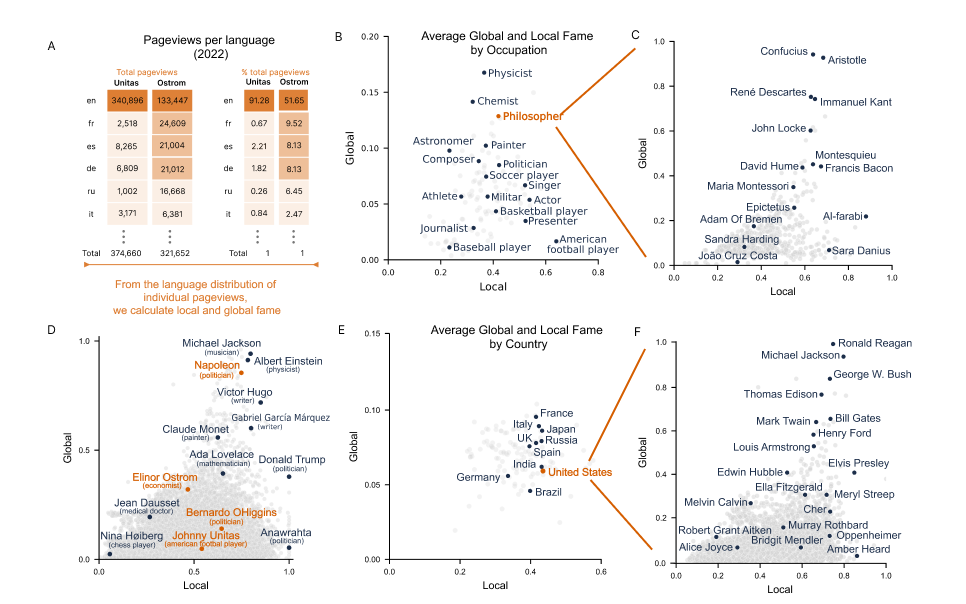
Locality and globality decompose collective memory into two dimensions. Some figures are intensely remembered in one cultural-linguistic sphere, while others receive attention across many languages.
Step 2 - Validate the measures with a randomized trivia game
Wikipedia pageviews are useful, but they are observational: people choose what to search for and read. To validate the measures behaviorally, the study uses data from an online trivia game where biographies were randomly assigned to players. Participants did not choose the figures; they had to answer randomized questions about them.
This design lets us test whether locality, globality, shared country, and shared language actually predict recognition.
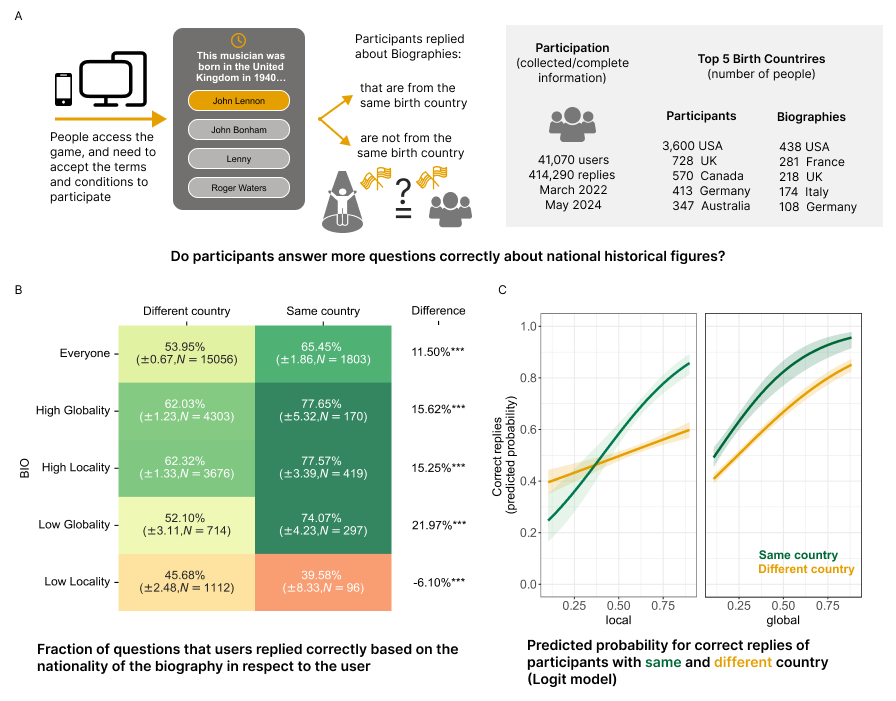
Participants answered randomized trivia questions about biographies. Correct responses were more frequent when the biography came from the participant’s country, and both locality and globality predicted recognition.
The local premium is large. In the descriptive results, participants answered correctly about 65.45% of the time when the biography came from their own country, compared with 53.95% for different-country biographies. In the regression models, sharing a country increases the probability of a correct answer by about 9 to 10 percentage points, while sharing a language adds about 5 points.
Step 3 - Follow memory around major life events
Finally, the paper asks how major events reshape attention. Using Wikipedia pageviews from 2015 to 2024, it follows biographies around deaths, Oscar wins, and Nobel Prizes.
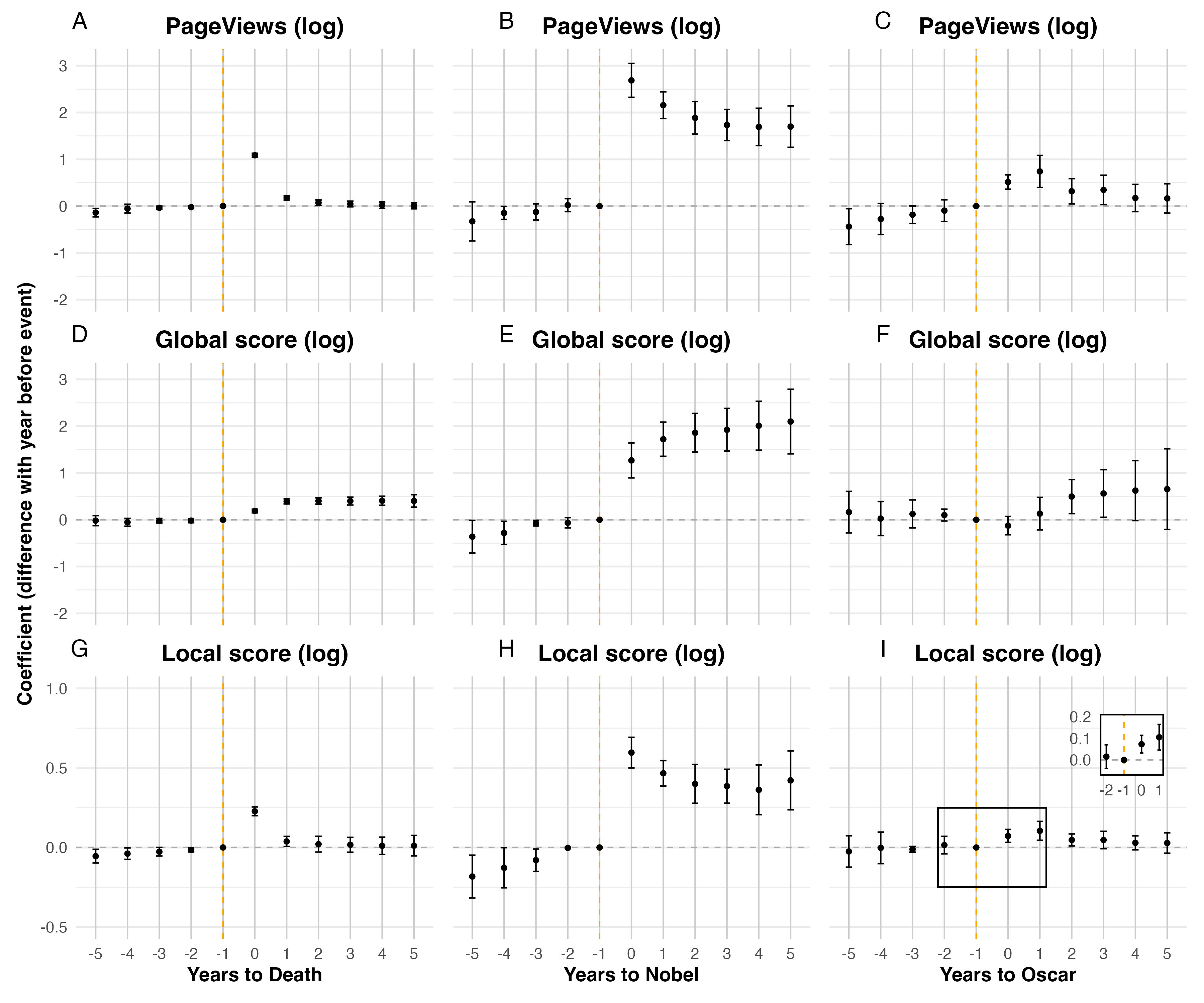
Deaths, Oscars, and Nobel Prizes reshape collective memory differently. Local attention tends to spike quickly, while globality often grows more slowly and persists longer.
The results show that events do not simply make people more famous in a uniform way. Deaths and Oscars generate sharp attention shocks, especially locally. Nobel Prizes, by contrast, produce a larger and more persistent global increase, suggesting that institutional recognition can help a biography cross cultural and linguistic boundaries.
Key findings
Finding 1 - Collective memory has more than one geography
Locality and globality are related, but not interchangeable. At lower levels of recognition they often move together, but among highly visible biographies they diverge. A figure can be locally dominant without being globally distributed, or globally recognized without being the most prominent figure in any single language context.
This matters because a one-dimensional fame score would flatten very different cultural footprints into the same number.
Finding 2 - Cultural proximity predicts recall
People remember culturally proximate figures more often. The study finds a robust local memory premium for shared country and shared language, even after accounting for the Wikipedia-derived locality and globality measures, biography characteristics, birth year, occupation, and birthplace.
The core point is behavioral: cultural proximity is not only visible in pageviews; it also appears in what people can recognize when questions are randomly assigned.
Finding 3 - Events change local and global memory differently
Deaths, Oscars, and Nobel Prizes all increase attention, but they do so with distinct local and global signatures. Locality often rises quickly and fades; globality can grow more slowly and last longer. The shape of memory depends not only on the event, but on whether the audience is local or global.
Keywords
Collective memory · Cultural proximity · Wikipedia · Computational social science · Digital traces · Online experiments · Locality · Globality
- Posted on:
- August 21, 2026
- Length:
- 6 minute read, 1127 words
- Categories:
- article
- Tags:
- collective memory cultural proximity Wikipedia computational social science digital traces online experiments
- See Also: